 Luca Berton
Platform Engineering Is Not "DevOps 2.0"
Let's clear this up immediately: platform engineering didn't replace DevOps. It solved a specific problem DevOps created — cognitive overload on development teams.
DevOps said "you build it, you run it." Platform engineering says "you build it, you run it — but we'll give you golden paths so you don't need to become an infrastructure expert to ship software safely."
The Key Differences
| Dimension | DevOps | Platform Engineering |
|---|---|---|
| Philosophy | Break down silos between dev and ops | Build self-service platforms for developers |
| Team structure | Full-stack responsibility per team | Dedicated platform team serving developer teams |
| Developer experience | Developers manage their own infra | Developers use abstractions (golden paths, templates) |
| Cognitive load | High — every team reinvents wheels | Low — platform absorbs complexity |
| Standardisation | Inconsistent across teams | Enforced through platform capabilities |
| Compliance | Each team handles compliance | Compliance built into platform (guardrails) |
| Scaling | Scales linearly with headcount | Platform enables sublinear scaling |
When DevOps Is Enough
- Small teams (< 30 developers) — The overhead of a platform team isn't justified
- Simple architectures — Monolith or simple microservices without complex infrastructure needs
- Low compliance burden — If you're not in a regulated industry, the compliance automation value is lower
- High infrastructure maturity — If teams are already effective at self-service infrastructure

Kubernetes Recipes
A practical guide for container orchestration and deployment by Grzegorz Stencel & Luca Berton (Apress).
Watch on Skillshare →When You Need Platform Engineering
- 50+ developers — Cognitive overload becomes real when teams can't keep up with infrastructure complexity
- Microservices at scale — 20+ services means 20+ teams making independent infrastructure decisions (chaos)
- Regulated industries — Compliance guardrails built into the platform beat trusting every team to get compliance right
- Deployment velocity matters — Platform engineering typically reduces deployment time by 60-80%
- Developer satisfaction is low — "I spend more time on infrastructure than on features" is the #1 signal
The Internal Developer Platform (IDP)
The core product of platform engineering is the Internal Developer Platform — a curated set of tools, APIs, and self-service capabilities:
- Service catalogue — Templates for creating new services with built-in best practices
- CI/CD pipelines — Standardised build and deployment pipelines developers don't need to configure
- Infrastructure provisioning — Self-service infrastructure (databases, queues, caches) via API or portal
- Observability — Pre-configured monitoring, logging, and alerting for every service
- Security — Automated scanning, secret management, and policy enforcement
- Documentation — API docs, runbooks, and architecture decision records in one place
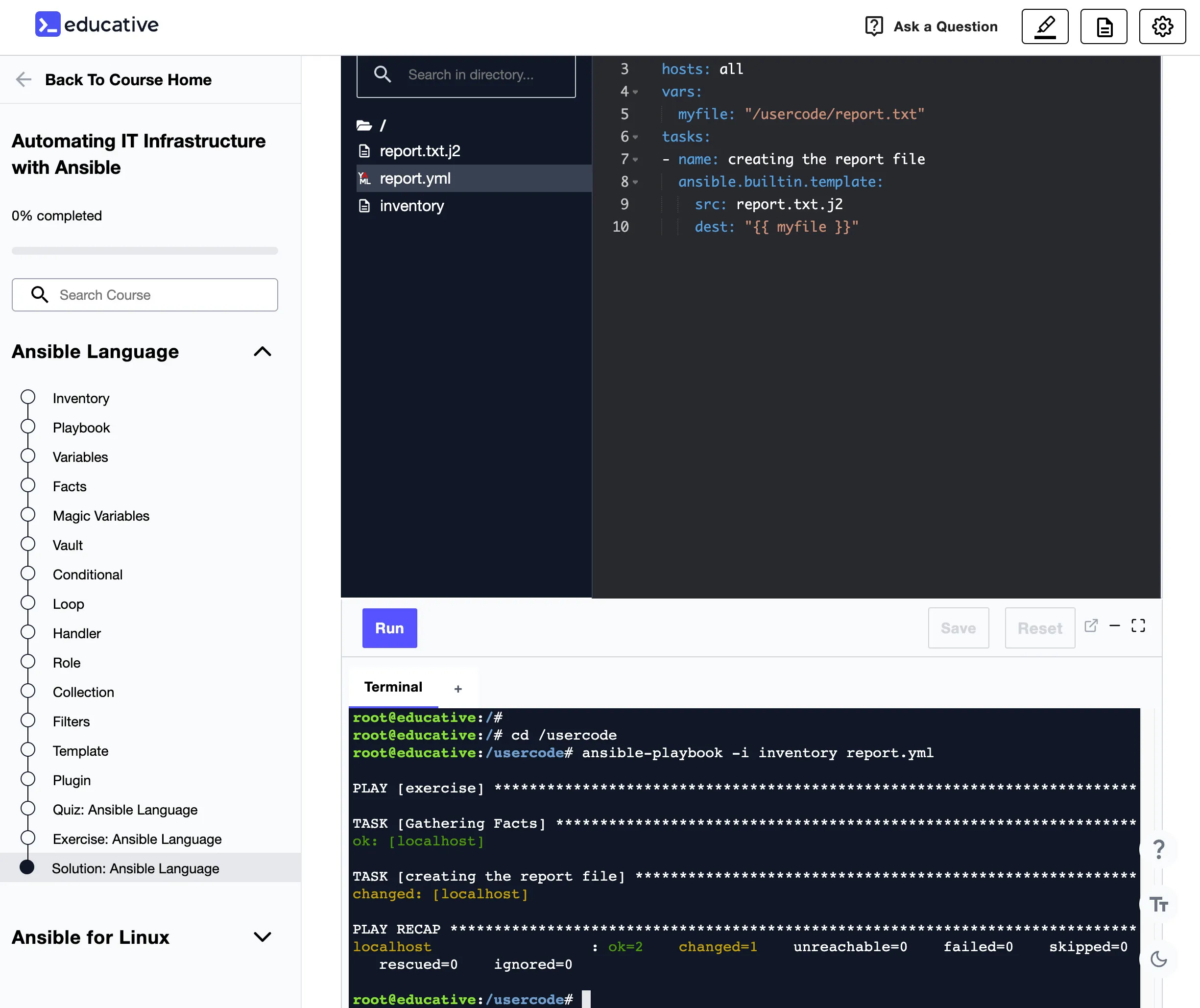
Learn Ansible Automation in 250+ Examples
Comprehensive Ansible training with real-world use cases.
Start on Educative →Transition Strategy: DevOps → Platform Engineering
- Identify the pain — Survey developers: what takes too long? What's confusing? Where do they waste time?
- Start small — Build the first golden path for the most common use case (e.g., deploy a web service)
- Treat it as a product — Platform team operates like a product team with developer-customers
- Measure adoption — Track platform adoption rate, deployment frequency, and developer satisfaction
- Iterate — Add capabilities based on developer feedback, not assumptions
Platform Engineering in Regulated Industries
This is where platform engineering delivers outsized value. In regulated industries (finance, healthcare, energy), every team making independent infrastructure decisions is a compliance risk. A well-designed platform encodes compliance requirements into the golden paths — developers can't accidentally deploy non-compliant infrastructure.
- DORA — Resilience testing, incident management, and audit logging built into the platform
- GDPR — Data classification, encryption, and retention policies enforced by platform capabilities
- EU AI Act — Model governance, risk management, and human oversight workflows in the platform
EU AI Act Compliance Checklist
40-point checklist covering risk classification, data governance, transparency, and human oversight. Based on the official regulation.
Get Free Checklist →